

How to Verify Ethically Sourced Diamonds
Table of Contents
- Understanding What Ethically Sourced Really Means
- Conflict-Free Diamond Certification: What to Look For
- Verifying Diamond Origin Traceability
- Natural vs Lab-Grown Diamond Ethics
- Questions to Ask When Buying a Diamond
- Your Verification Checklist for Ethically Sourced Diamonds
- Frequently Asked Questions
Last Updated: October 21, 2026
Understanding What Ethically Sourced Really Means
Ethically sourced diamonds means stones that come from responsible mining operations and are tracked through a documented supply chain. The term covers several concerns: conflict status, worker welfare, environmental impact, and community benefit.
Here's what matters most. To verify ethically sourced diamonds, you should confirm each stone has a clear origin story. You need to know where it came from, who mined it, and how it moved from the ground to your jeweler's hands. This transparency is the foundation of ethical sourcing.
The term itself is broader than "conflict-free." A diamond can be conflict-free but still come from a mine with poor labor practices or severe environmental damage. At Certified Fine Jewelry, we look at the full picture when sourcing stones.
Three main categories define ethical sourcing:
- Conflict-free status: The stone didn't fund armed conflict
- Labor conditions: Workers were paid fairly and worked safely
- Environmental stewardship: Mining operations minimized ecological harm
Many consumers assume all diamonds are equal once certified. They're not. The certification tells you one part of the story. The sourcing practices tell you the rest.
Conflict-Free Diamond Certification: What to Look For
Conflict-free certification is the most visible ethical marker, but it's just the first step. A conflict-free diamond certification confirms the stone didn't finance armed conflict in producing countries. It does NOT guarantee fair wages, safe working conditions, or environmental protection.
The Kimberley Process System of Warranties is the main conflict-diamond control (What Is The Kimberley Process?). It tracks diamonds from mine to retail to prevent conflict stones from entering the supply chain. But the system has limits. It focuses narrowly on conflict funding, not broader labor or environmental issues.
When you buy a diamond, look for documentation that shows:
- Kimberley Process compliance: The stone passed through the conflict-diamond tracking system
- Chain of custody records: Documentation showing the diamond's path from mine to jeweler
- Third-party verification: Independent labs or auditors confirmed the stone's status
Ask your jeweler for the actual certificate. Don't accept vague promises. A real conflict-free diamond comes with paperwork. If a seller can't produce documentation, that's a red flag.
The Kimberley Process official standards outline the requirements for conflict-diamond prevention. Understanding these standards helps you evaluate what your jeweler is claiming.
Verifying Diamond Origin Traceability
Diamond origin traceability means you can trace the stone backward from your jeweler to the mine. This is harder than it sounds. Most diamonds pass through multiple middlemen, each adding a layer of distance between you and the source.
True traceability requires documentation at every step. The mine records the extraction. The exporter documents the shipment. The importer verifies receipt. The wholesaler tracks inventory. Finally, your jeweler records the sale. Each step should be documented.
Documentation You Should Request
When buying an ethically sourced diamond, request these specific documents:
- Gemological certificate: From labs like GIA or AGS, grading the stone's quality
- Origin disclosure: Where the diamond was mined (country and ideally region)
- Chain of custody records: Documentation of who handled the stone at each step
- Sourcing affidavit: A statement from the supplier confirming ethical sourcing practices
- Audit reports: Third-party verification of mining or supplier practices (when available)
A reputable jeweler will provide these without hesitation. Our Natural Princess Cut Diamond Ring comes with a Gemological Appraisal Laboratory certificate and full sourcing details.

The certificate should include the stone's characteristics: cut, color, clarity, carat weight. It should also note where the diamond was sourced. If the certificate is vague about origin, ask why.
Red Flags in Sourcing Claims
Watch for these warning signs when evaluating a jeweler's ethical claims:
- No documentation available: They can't produce certificates or chain of custody records
- Vague origin information: "Conflict-free" is mentioned but no specific country or mine is named
- No third-party verification: All claims come from the seller with no independent audit
- Inconsistent pricing: The stone costs significantly less than comparable certified diamonds
- Pressure to decide quickly: They discourage you from verifying claims independently
- Generic statements: "We source responsibly" without specific practices or standards named
A legitimate seller welcomes scrutiny. They'll answer detailed questions about sourcing practices. They'll provide documentation willingly. If a jeweler becomes defensive about verification, move on.
Natural vs Lab-Grown Diamond Ethics
The natural versus lab-grown debate adds complexity to ethical sourcing because the two pathways carry different ethical risks, and neither is automatically the more responsible choice. The useful question is not "which category is ethical?" but "what claims does this specific stone's pathway make, and what evidence backs them?"
Natural diamonds come from the earth. Mining can create significant environmental impact, land disturbance, water use, and habitat disruption, and labor concerns vary widely by operation and country. But natural diamonds also support mining communities, and some operations are independently audited for labor and environmental practices. The ethical difference between a responsibly audited mine and an unverified one is substantial, and it is not visible in the stone itself.
Lab-grown diamonds are created in controlled environments. They eliminate mining-related land disturbance and the associated labor risks at the mine site. They also eliminate mining jobs in producing countries, which affects those communities economically. And lab-grown production is energy-intensive: some labs use renewable energy, while others rely on fossil-fuel-heavy grids. The ethical difference between a renewably powered lab and a coal-powered one is real, and it is rarely disclosed at the retail counter.
Here is the trade-off in practical terms:
- Mined pathway: Verify origin country and region, mine-level labor and environmental audits, and chain-of-custody records. The ethical claim depends on the specific mine, not the category.
- Lab-grown pathway: Verify the lab's location, its energy sources, and its labor standards. The ethical claim depends on the specific lab, not the category.
- Recycled or reclaimed diamonds: These re-enter the market without new mining, but they still carry the original stone's unknown provenance unless documented. Recycled status is not a substitute for origin records.
A common pattern is that sellers emphasize the category ("natural" or "lab-grown") while staying vague about the specific operation behind the stone. That is the gap to probe. For a natural diamond, ask for the mine or region and any independent audit of that operation. For a lab-grown stone, ask which lab produced it and what energy sources power that facility. If the seller cannot answer, the ethical claim is unsubstantiated regardless of category.
Natural Princess Cut Diamond Ring Size 6.5 14k Gold 0.35 TCW Certified $3,750 →
Neither option is automatically more ethical. The real question is whether the specific diamond, natural or lab-grown, came from responsible practices, and whether the seller can document that claim rather than simply assert it.
At Certified Fine Jewelry, we work with natural diamonds sourced from responsible suppliers. Our handcrafted pieces feature ethically sourced materials combined with artisanal craftsmanship.
Questions to Ask When Buying a Diamond
Before purchasing, ask your jeweler these specific questions, and pay as much attention to how they answer as to what they say. The goal is to separate documented claims from assurances.
1. Where was this diamond mined? Ask for the specific country, and ideally the region or mine name. A country-level answer is a start; a mine-level answer is stronger.
2. Can you provide the complete chain of custody documentation? Chain-of-custody records show who handled the stone at each step from mine to retailer. Ask to see the actual records, not a summary.
3. Which gemological laboratory graded this stone? GIA and AGS are the most widely respected labs. A grading report establishes the stone's identity and quality, cut, color, clarity, carat weight, and often fluorescence and treatment status.
4. Has the mine or supplier been independently audited for labor and environmental practices? Ask who performed the audit and what its scope covered.
5. What is your written sourcing policy? Ask for documentation you can review, not a verbal assurance. A written policy should name the standards the seller follows and the documentation they require from suppliers.
6. Can you explain the difference between this stone's sourcing and others you carry? This question tests whether the seller actually knows the supply chain or is repeating a category-level claim.
7. If the diamond is lab-grown, what energy sources power the lab? Lab-grown stones avoid mining impacts but vary widely in energy use. Ask which lab produced the stone and whether it discloses its energy sources.
Warning signs in seller responses:
- Evasive or generic answers: "We only source responsibly" with no named standards, mines, or auditors.
- Documentation you cannot see: Promises of certificates "on request" that never materialize, or summaries instead of actual records.
- Pressure to decide quickly: Discouraging independent verification or follow-up questions.
- Category claims standing in for evidence: "It's conflict-free" or "it's lab-grown" offered as a complete ethical answer.
- Inconsistent pricing: A stone priced significantly below comparable certified diamonds without a documented reason.
Listen carefully to the answers. A knowledgeable jeweler will provide specific details, explain their sourcing standards clearly, and welcome scrutiny. They won't use vague language or make promises they can't document.
The Gemological Institute of America's diamond grading standards set the industry benchmark for stone evaluation. Understanding their criteria helps you evaluate certification quality, and helps you see why a grading report answers a different question than a sourcing audit.
Your Verification Checklist for Ethically Sourced Diamonds
Use this checklist to verify ethically sourced diamonds when evaluating a purchase:
- Request the gemological certificate from a recognized lab (GIA, AGS, or equivalent)
- Ask for the specific country and region where the diamond was mined
- Request chain of custody documentation showing the stone's path to the jeweler
- Verify the jeweler has a written sourcing policy you can review
- Ask whether the mine or supplier has been independently audited
- Confirm the stone meets Kimberley Process standards for conflict-free status
- Request an affidavit or statement confirming ethical sourcing practices
- Ask about labor conditions at the mine or lab where the stone originated
- Inquire about environmental practices and impact mitigation
- Verify the jeweler's reputation through independent reviews and ratings
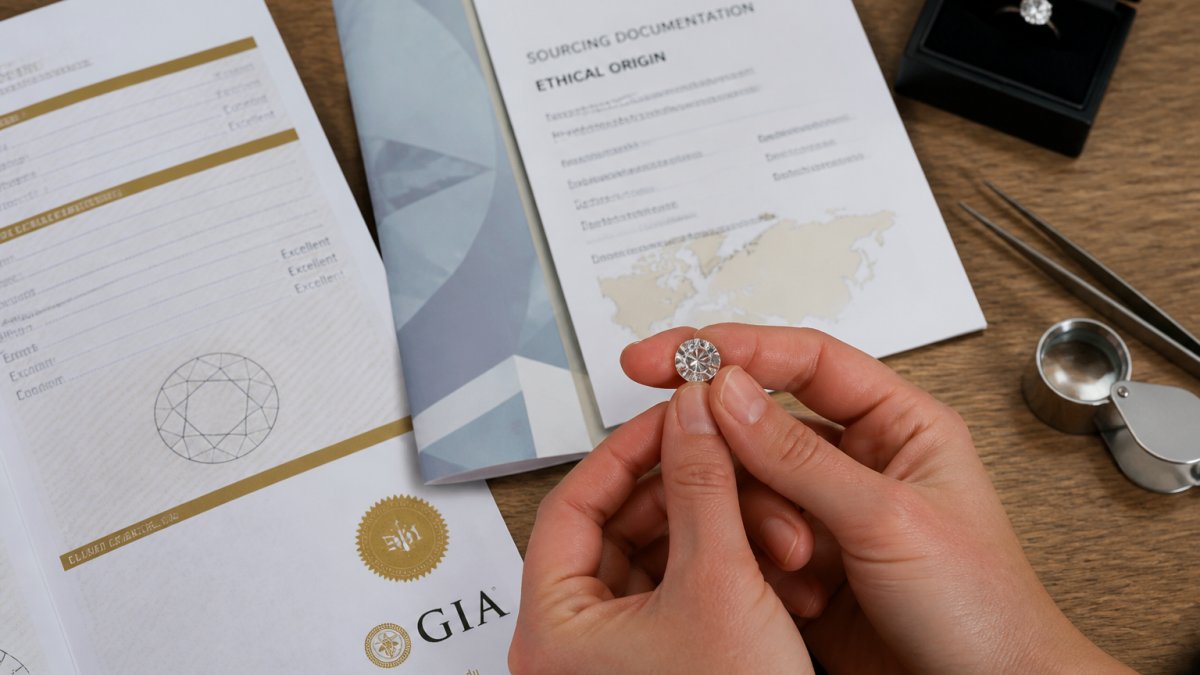
Don't rush this process. Take time to gather documentation. Ask follow-up questions if answers seem incomplete. A legitimate jeweler will support your due diligence.
Certified Fine Jewelry has been trusted since 2002. Our 4.9 rating on 1stDibs and 99.6% positive feedback on eBay reflect our commitment to authentic, ethically sourced pieces.
Frequently Asked Questions
What documents should a jeweler provide to support an ethical sourcing claim?
A reputable jeweler should provide a grading report from an independent gemological laboratory (such as GIA), a certificate of authenticity, chain of custody documentation showing the diamond's path from source to retailer, and a sourcing statement disclosing the country of origin and mining practices. If the diamond carries Kimberley Process certification, this should be documented. Certified Fine Jewelry provides certification and appraisal according to GIA standards with every diamond.
How can you tell whether a diamond is natural or lab-grown?
A certified gemological laboratory can distinguish natural from lab-grown diamonds through specialized testing. Natural diamonds show specific growth patterns and may contain trace elements that reveal their geological history. Lab-grown diamonds, while chemically identical, have different growth characteristics. Always request a grading report that explicitly states whether the diamond is natural or lab-grown. This distinction matters for ethical sourcing because natural and lab-grown diamonds have different supply chains, environmental impacts, and labor considerations.
Does a diamond certificate prove that it was ethically sourced?
A grading certificate proves the diamond's characteristics (cut, color, clarity, carat weight) but does not independently verify ethical sourcing. Certification from a gemological laboratory confirms the stone's authenticity and quality, not its origin or mining practices. To verify ethical sourcing, you need additional documentation: chain of custody records, sourcing statements, Kimberley Process certification (if applicable), and direct communication with the retailer about their supplier standards and third-party audits.
What does conflict-free mean when buying a diamond?
Conflict-free diamonds are stones that were not mined in war zones or used to finance armed conflict. The Kimberley Process Certification Scheme was established to prevent conflict diamonds from entering the mainstream supply chain. However, conflict-free status is narrower than full ethical sourcing, a diamond can be conflict-free but still sourced from operations with poor labor conditions or significant environmental impact. When verifying ethical sourcing, ask about conflict-free certification AND worker safety, fair wages, and environmental stewardship practices beyond conflict status.
Verifying ethically sourced diamonds requires effort, but it's worth it. You're not just buying a stone, you're making a statement about the practices you support. Certified Fine Jewelry makes this process easier by providing complete documentation and transparent sourcing information with every handcrafted piece. Learn more about responsible jewelry sourcing practices to deepen your understanding. Shop now and own a diamond you can feel good about.