

Why Handcrafted Jewelry Costs More: A Buyer's Guide
Table of Contents
- The Real Price of Handcrafted Jewelry: What You're Actually Paying For
- Materials and Gemstone Costs: The Foundation of Price
- Labor Hours and Artisan Skill: Why Handmade vs Mass-Produced Jewelry Differs So Much
- Design and Custom-Designed Jewelry: The Cost of Originality
- Factors That Determine Jewelry Prices: Complexity, Production Methods, and Craftsmanship
- Handcrafted Jewelry Quality and Durability: Long-Term Value Over Time
- Overhead, Packaging, and Ethical Sourcing: The Hidden Costs Behind the Price Tag
- Is Handcrafted Jewelry Worth the Investment?
- Frequently Asked Questions
Last Updated: October 19, 2026
The Real Price of Handcrafted Jewelry: What You're Actually Paying For
When you buy handcrafted jewelry, you're investing in time, skill, materials, and intention that mass production cannot replicate. At Certified Fine Jewelry, four generations have gone into understanding exactly what each piece requires.

Most people assume higher prices reflect greed or brand markup. In reality, handcrafted jewelry costs more because it IS more: every layer, from sourcing to final finishing, demands human expertise and time that factory production eliminates. Understanding why handcrafted jewelry costs what it does requires examining each component of production.
This guide breaks down where that cost comes from, so you can judge whether a piece is worth the investment.
Materials and Gemstone Costs: The Foundation of Price
The materials themselves represent a significant portion of handcrafted jewelry pricing. Unlike mass-produced pieces that use standardized, lower-grade materials to hit a price point, artisan jewelers source materials based on quality first.
Precious metals like 18K gold, platinum, and sterling silver carry real costs that fluctuate with market prices. A single handcrafted ring might use 5-8 grams of pure gold, not plating over base metal. A genuine sapphire or emerald sourced ethically costs exponentially more than synthetic or lower-quality stones.
Ethical sourcing, ensuring gemstones don't fund conflict or exploit workers, requires verification, documentation, and trusted supplier relationships. Mass producers skip this, buying in bulk from the cheapest sources and passing generic certifications to buyers. Certified Fine Jewelry works directly with suppliers to verify origins for every colored gem and diamond.
When you pay for handcrafted jewelry, you're paying for real materials with verified provenance, not commodity-grade substitutes.
Labor Hours and Artisan Skill: Why Handmade vs Mass-Produced Jewelry Differs So Much
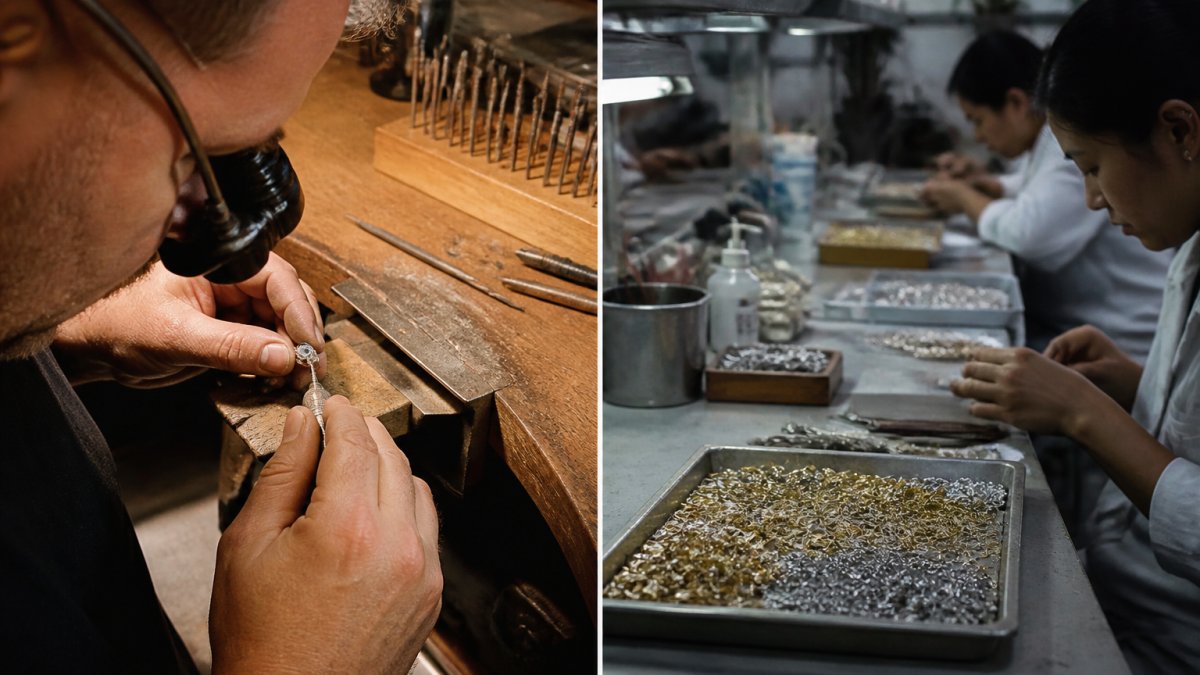
A handcrafted piece takes dozens of hours of skilled labor; a mass-produced equivalent takes minutes of machine time.
A jeweler hand-forges metal, corrects mistakes, and starts over when the design demands it. They set each stone by hand, securing it with tiny prongs, then file, polish, and finish surfaces to exacting standards.
A factory worker stamps, casts, or presses hundreds of identical pieces per shift, with minimal quality control and rushed finishing. The labor cost per piece is a fraction of an artisan's.
Artisan skill commands a premium. A jeweler with decades of experience, like the four-generation legacy at Certified Fine Jewelry, understands metal behavior, stone properties, and problem-solving no training manual teaches, expertise built into every piece.
When you compare handmade vs mass-produced jewelry, you're comparing hundreds of hours of expert craftsmanship against machine-assisted assembly.
Design and Custom-Designed Jewelry: The Cost of Originality
Mass production spreads design costs across thousands of identical units. Handcrafted jewelry thrives on uniqueness.
Every piece at Certified Fine Jewelry is designed and made by hand; no two are identical. A designer sketches concepts, refines them, and adjusts for construction feasibility. Custom-designed jewelry amplifies this cost because the process serves one client's vision, not a catalog.
The design phase involves consultation, iteration, and often multiple revisions before fabrication begins. Mid-production client changes may force the artisan to restart sections of the work.
Mass producers offer pre-designed pieces in fixed variations, their design cost absorbed years ago across thousands of units.
Factors That Determine Jewelry Prices: Complexity, Production Methods, and Craftsmanship
Two similar-looking handcrafted rings can differ in price by hundreds or thousands of dollars. The difference comes down to four levers: complexity, production method, maker experience, and customization.
Complexity of the piece. Complexity is the biggest driver of labor time. A simple half-round band might take a few hours of finishing; a ring with a raised bezel, milgrain edging, filigree, and a multi-stone halo takes several times longer because every element must be formed, fitted, soldered, and finished without damaging the others. A single bezel-set stone is quick, while a pavé band requires each tiny stone seated and tightened individually.
Production method. Hand fabrication starts from sheet, wire, and tubing; the maker saws, files, bends, solders, and finishes, gaining precise control but working slower. Casting is faster and repeatable, but mold costs and cleanup still matter, and cast pieces often need significant finishing to remove sprue marks and porosity. Stamping is cheapest at volume but least flexible. Many studios use a hybrid: cast components finished and assembled by hand. The method affects labor time, repairability, and durability.
Craftsmanship and maker experience. A master jeweler and an apprentice can perform the same task in very different times with very different results. Experienced makers recognize problems early and correct them before they become expensive, producing cleaner solder seams, more even finishes, and more secure settings. A piece made by an experienced hand may cost more per hour but require less rework and long-term maintenance.
Customization and client involvement. Custom work adds consultation, sketches, revisions, and sometimes wax or CAD models before metal is cut. A stock design amortizes that creative work across many pieces; a one-off commission does not. Changes after fabrication begins may require remaking components.
A simpler band might take a fraction of that labor. The final price reflects specific, identifiable inputs, not arbitrary markup.
These factors compound. A complex handcrafted piece made for a specific client costs more than a simple cast catalog piece, but it may last longer, fit better, and be easier to maintain. When comparing two pieces, ask which levers are at work, that tells you more than the label.
Handcrafted Jewelry Quality and Durability: Long-Term Value Over Time
Durability is where handcrafted jewelry can justify its premium, but only if you know what to look for. The difference between a piece that lasts decades and one that fails in a few years shows up in construction, finishing, material disclosure, and repairability.
Vintage John Hardy 18K Gold Purple Amethyst Jaisalmer Clip On Earrings 925 JH124 →
Construction and joinery. Check solder seams for clean, smooth finishes; chain links for proper closure and consistent shape; earring posts and backs for sturdiness.
Stone setting. Prongs should be even, rounded, and snug; bezels should fully surround the stone with no gaps; pavé stones should sit level and tight. Glued stones are a red flag in fine jewelry. Ask how stones are set, and inspect under magnification if possible.
Finishing and surface quality. A hand-finished piece has a more even polish and softer transitions. Watch for inconsistent finish, thin plating at edges, or rough interiors and pendant backs. Makers who care about longevity finish hidden surfaces too, since those affect comfort and wear.
Material disclosure. A reputable maker should disclose metal content, stone types and treatments, and whether the piece is solid or plated. Plated jewelry wears through at high-contact points; solid metal can be polished and repaired for decades. Refusal to disclose is a warning sign.
Repairability. Handcrafted pieces are often easier to repair because they use traditional techniques and solid materials, prongs can be re-tipped, joints re-soldered, bands resized. Mass-produced pieces with plated finishes, glued stones, or proprietary components may be impossible to repair economically.
Expected lifespan and cost per wear. A handcrafted piece that costs more upfront but lasts for decades of regular wear may cost less per year than a cheaper piece replaced every few years, a more honest comparison than sticker price alone.
A note on ethical sourcing claims. Ethical or traceable sourcing claims vary widely in what they verify. Look for specific suppliers, documentation, and whether the claim covers both metals and stones. A named supplier or recognized certification means more than vague “responsibly sourced” language.
Use these indicators as a checklist: construction, stone setting, finishing, material disclosure, repairability, and sourcing transparency. A higher price is easier to justify when you can see where the quality shows up; when a piece fails these standards, the premium may be branding rather than craftsmanship.
Overhead, Packaging, and Ethical Sourcing: The Hidden Costs Behind the Price Tag
Beyond materials and labor, several less-visible costs contribute to handcrafted jewelry pricing.
Business overhead for artisan makers is substantial: rent, utilities, insurance, tools, equipment maintenance, and training. A four-generation business also invests in quality control, customer service, and infrastructure. Mass producers spread overhead across thousands of units; artisans across dozens or hundreds.
Packaging and presentation matter more for handcrafted pieces, which ship individually in custom packaging that protects the piece and conveys the care behind it. Mass-produced jewelry ships in bulk with minimal packaging.
Ethical sourcing verification adds cost that mass producers avoid. Certified Fine Jewelry documents the origin of every gemstone and metal, ensuring conflict-free sourcing and fair labor practices, requiring supplier relationships, third-party verification, and record-keeping. Mass producers skip these steps or rely on generic certifications.
Customer service and customization support require time and expertise. Handcrafted makers work directly with clients on questions, concerns, and care guidance; mass producers offer standardized call-center support.
Is Handcrafted Jewelry Worth the Investment?
The answer depends on what you're buying and why.
If you want a piece to wear occasionally and discard in a few years, mass production is cheaper. If you want something that becomes part of your life, that your children might wear someday, that holds its beauty and structural integrity through decades of actual use, handcrafted jewelry is worth every penny.
Consider the value equation. A handcrafted piece costs more upfront but lasts longer, maintains its appearance, requires minimal repair, and often appreciates in desirability over time. A mass-produced piece costs less upfront but may degrade quickly and need replacement within years.
| Factor | Handcrafted Jewelry | Mass-Produced Jewelry |
|---|---|---|
| Material Quality | Solid, verified, ethically sourced | Plated, generic sourcing |
| Labor Investment | 20-40+ hours per piece | Minutes per piece |
| Design Uniqueness | One-of-a-kind or custom | Standardized, repeated |
| Durability | Decades of typical wear | 2-5 years typical wear |
| Repair Needs | Minimal, easily maintained | Frequent, often irreparable |
| Long-Term Value | Holds value, becomes heirloom | Depreciates quickly |
| Ethical Sourcing | Verified and documented | Minimal verification |
The real question isn't whether handcrafted jewelry is expensive, it's whether you're willing to invest in something that will outlast trends, survive actual use, and potentially become an heirloom. Certified Fine Jewelry pieces, handcrafted in Brooklyn with four generations of expertise, represent that kind of investment.
When you understand what goes into handcrafted jewelry, the materials, the labor, the expertise, the ethical sourcing, the durability, the price isn't surprising. It's justified. You're not paying for a brand or a status symbol. You're paying for craftsmanship, quality, and something that will genuinely last.
At Certified Fine Jewelry, we believe handcrafted jewelry worth the investment starts with understanding exactly what you're buying. Our pieces are designed and made by hand in Brooklyn, featuring ethically sourced fine colored gems and diamonds that reflect our four-generation commitment to quality. Every piece is one-of-a-kind, built to last, and backed by our reputation since 2002. Explore our collection of handcrafted earrings, including pieces like the Vintage John Hardy 18K Gold Purple Amethyst Jaisalmer Clip On Earrings at $490, which exemplifies the craftsmanship and materials that make handcrafted jewelry a true investment. Shop now and discover why discerning collectors choose Certified Fine Jewelry.

Frequently Asked Questions
Why does handcrafted jewelry cost more than mass-produced jewelry?
Handcrafted jewelry costs more because each piece requires individual artisan attention, premium materials, and significant labor hours. Mass production uses automated machinery and lower-cost materials to reduce expenses. When you buy handcrafted jewelry, you're paying for the maker's expertise, time spent on design and fabrication, ethically sourced materials, and the uniqueness of a one-of-a-kind piece that won't be replicated elsewhere.
What factors determine jewelry prices the most?
The primary factors that determine jewelry prices are material costs (precious metals and gemstones), labor hours required for handwork, design complexity, craftsmanship level, production methods, and overhead expenses. A custom-designed piece with rare gemstones and intricate detailing commands a higher price than a simple sterling silver design. Additionally, ethical sourcing and fair labor practices add to the final cost but ensure responsible production.
Is handcrafted jewelry worth the higher price?
Yes, handcrafted jewelry offers superior long-term value. Each piece is designed to last as an heirloom, with meticulous attention to durability and finishing. Unlike mass-produced items that may deteriorate quickly, handcrafted pieces maintain their beauty and structural integrity for decades. The uniqueness, artisan quality, and ethical sourcing justify the investment, especially for significant life milestones or pieces intended to pass down through generations.
How much does labor affect the cost of handmade jewelry?
Labor, including design sketching, metalwork, stone setting, finishing, and quality control, all performed by skilled artisans, significantly influences the cost of handmade jewelry. The jeweler's experience level, the intricacy of the design, and the precision required all contribute to labor costs.