

How to Identify High-Quality Handcrafted Jewelry
Quick Summary
Handcrafted jewelry is shaped, set and finished by hand rather than stamped or cast in bulk. Judge its quality by four checkable things: the materials, the construction, how the stones are secured, and how the surfaces are finished.
- Check the hallmark, such as 925 for sterling silver or 14k or 18k for gold, then confirm it with seller documentation.
- Compare weight to size and check edge thickness, since light or thin pieces may be hollow or plated.
- Test the prongs and setting by gently tilting the piece; a rocking stone signals a loose setting.
- Judge finish by running a fingernail along edges and viewing the polish under raking light.
- When buying online, request the six standard views and ask specific questions about metal, stones and repairs in writing.
Table of Contents
- What Handcrafted Jewelry Means and How It Differs from Mass-Produced Pieces
- Handcrafted vs Mass-Produced Jewelry: A Comparison of Construction and Value
- Signs of Quality Jewelry Craftsmanship in Metal, Stones and Finish
- How to Inspect Jewelry Settings for Quality
- Step-by-Step Inspection Checklist for Clasps, Polish and Structure
- Telling Intentional Handmade Variation Apart from Defects
- Assessing Handcrafted Jewelry from Photos and Online Listings
- Choosing Your First Handcrafted Piece and Caring for It Over a Lifetime
- Frequently Asked Questions
What Handcrafted Jewelry Means and How It Differs from Mass-Produced Pieces
Last Updated: October 28, 2026
Handcrafted jewelry is shaped, set and finished by hand rather than stamped or cast in bulk. Certified Fine Jewelry designs and makes its collection by hand in Brooklyn, with every piece set in-house, so each carries the marks of a specific maker.
The two categories look similar in a retail photo and differ sharply in the hand. A mass-produced ring is cast from a mold, with template-formed prongs and machine-finished surfaces. A handcrafted ring more often shows small, deliberate variations: a slightly uneven prong height, a polish that stops short of a seam, a band that is not perfectly circular.
Handcrafted quality comes down to four checkable things: the materials, the construction, how the stones are secured, and how the surfaces are finished.
Handcrafted vs Mass-Produced Jewelry: A Comparison of Construction and Value
The core difference is where decisions are made. In mass production the design is fixed in advance and every unit matches the last. In handcrafted work the maker decides at each stage, which gives the piece individuality but makes quality depend on that maker's skill.
Here is how the two compare across the areas that matter most when you are buying:
| Area | Mass-Produced | Handcrafted |
|---|---|---|
| Construction | Cast or stamped from molds | Assembled and shaped by hand |
| Consistency | Near-identical units | One of a kind, small variation |
| Stone setting | Often machine-set, uniform | Set individually, checked by eye |
| Finish | Machine-polished, even | Hand-finished, may vary slightly |
| Typical value driver | Volume and brand | Materials and workmanship |
Be cautious with the word "handmade" on its own. Many production pieces involve some hand finishing, and some handcrafted claims refer only to a final polish. Ask what the maker actually does by hand.
Signs of Quality Jewelry Craftsmanship in Metal, Stones and Finish
Quality shows up in three places you can examine: the metal, the stones and the finish.
Metal. Start with the hallmark or maker's mark.
Then move from the stamp to the metal itself. A few objective checks separate solid from hollow or plated work:
- Weight-to-size ratio. A piece that feels light for its apparent volume may be hollow, thinly cast or plated over a base metal. Compare it with a piece you own in the same metal and approximate size.
- Edge thickness. Look at the inside of a band, the back of a pendant or the underside of a setting. Solid metal has visible thickness at the edges; plated or hollow work often looks thin or shows a seam where the plating ends.
- Color consistency. On gold, check that the color is even across the piece, including inside the band and under the setting. Patches of a different tone can indicate plating, solder of a different alloy, or a repair.
Stones. Quality stones are chosen for color, clarity and cut, and should be described precisely.
You can also check a few things yourself:
- Setting fit. The stone should sit level in its opening, with the girdle (the widest band around the stone) sitting evenly beneath the prongs. Uneven gaps suggest the stone was forced into a setting not built for it.
- Surface condition. Under good light, look for chips, abrasions or scratches on the facet junctions. A stone that is scratched on the surface may be softer than its description implies.
- Consistency across a pair. On earrings or matched stones, compare color, size and cut side by side. Noticeable mismatch is a sign of lower-grade matching.
Finish. A well-finished piece has smooth edges, even polish and no visible scratches or tool marks where you would expect clean work.
Use these finish checks as objective tests rather than impressions:
- Run a fingernail along edges. A well-finished edge glides; a sharp or rough edge catches. Rough edges on the inside of a band or the back of a pendant are a common sign of skipped finishing steps.
- Look at the polish under raking light. Tilt the piece so light skims the surface. Scratches, pitting and dull patches that are invisible head-on will show up clearly.
- Check the seams. Solder joins should be clean and largely invisible, with no bubbling, dark residue or a visible line of a different color.
A single weak result is a question to ask, not a verdict. Two or more weak results in the same area, especially on metal thickness, stone security or finish quality, are a reason to slow down before buying.
How to Inspect Jewelry Settings for Quality
The setting holds the stone and is the most common point of failure. Inspect it first.
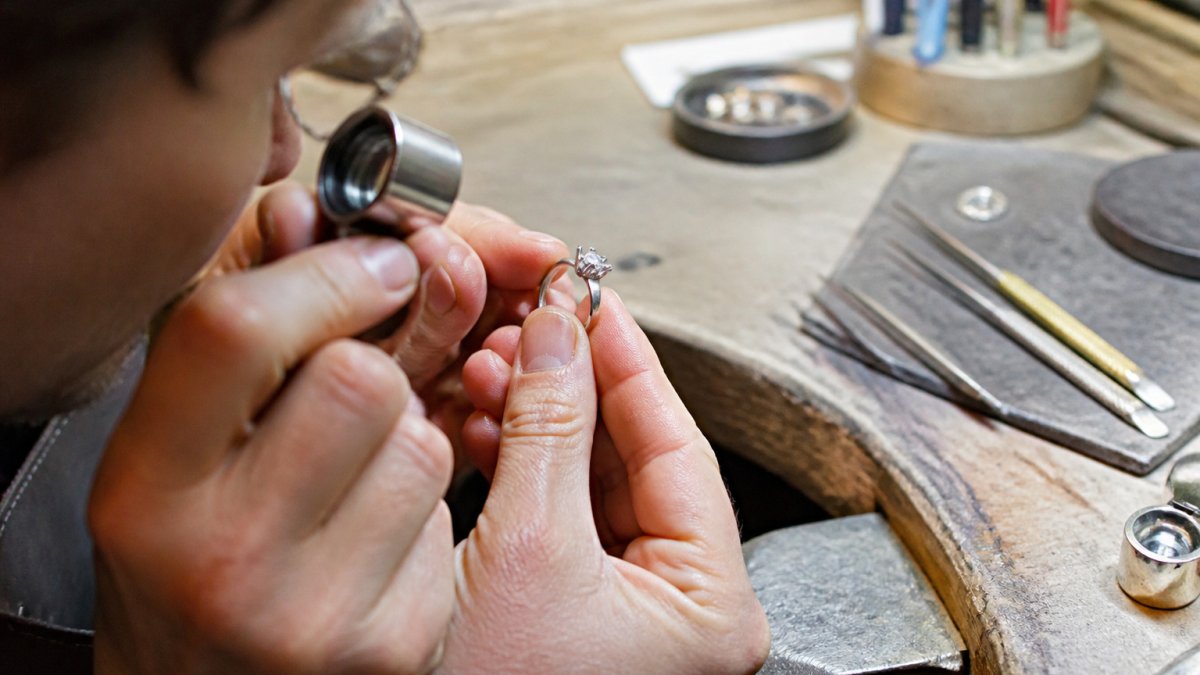
!A jeweler's hands holding a ring under a loupe at a bright workbench, with prong settings visible in close focus
Start with the prongs.
Next, look at how the stone sits.
Finally, check the inner band and underside of the setting.
A setting that looks secure in one photo can still be loose.
Step-by-Step Inspection Checklist for Clasps, Polish and Structure
Use this checklist when you have a piece in hand, or when you have the seller's photos and description in front of you. Work through it in order.
MIKIMOTO Akoya Pearl Leaf Brooch Pin Sterling Silver Signed M463 →
- Check the hallmark. Confirm the metal stamp and whether it matches the description.
- Weigh the piece. Compare the stated weight with your expectation for its size and metal.
- Test the clasp. Open and close it several times. It should click firmly, hold without slipping and not feel flimsy.
- Inspect the clasp housing. Look for solder joins, cracks or bent parts where the clasp attaches to the chain or band.
- Examine the links or band. On chains, check that each link closes fully. On rings, confirm the band is round and uniform.
- Look at the polish. Scan for scratches, pitting and dull patches. Check the edges and inner surfaces.
- Check the stones. Confirm each stone sits level, is secure and matches the stated type and size.
- Assess the structure. Flex the piece gently. It should feel rigid, not springy or loose at the joins.
If a piece fails more than two of these checks, treat that as a reason to ask questions before buying, not as a deal-breaker on its own.
Telling Intentional Handmade Variation Apart from Defects
This is where handcrafted jewelry is most often misjudged: some irregularity is the signature of handwork, and some is a flaw that will cause problems later.
Intentional variation appears as small, even-looking differences: a slightly different curve in two matching prongs, a very slightly oval band, or a surface texture that is part of the design. These do not affect how the piece holds together or wears.
Defects are different in kind. Look for cracks, especially near solder joins or at the base of prongs.
A useful test is to ask whether the irregularity affects function. A quirk that looks unusual but leaves the piece secure and intact is the handmade signature.
Assessing Handcrafted Jewelry from Photos and Online Listings
Most buyers cannot handle a piece before purchase, so the listing has to do the work.
Step 1: Request the right photos. A listing that shows only the front of a piece is not enough to judge craftsmanship. Ask the seller for:
- A straight-on front view in neutral, diffused light.
- A close-up of the hallmark or maker's mark, legible enough to read.
- A close-up of the setting from the side, showing the prong tips and the stone's girdle.
A seller confident in the piece will usually provide these without fuss.
Step 2: Read the photos like an inspector. Work through the same checks you would use in person, adapted to a screen:
- Hallmark. Zoom in and confirm the stamp matches the stated metal and karat. A blurry or missing hallmark photo is a reason to ask again.
- Prong tips. Look for even height, neat tips and no cracks or thin spots. Compare the prongs to each other; a visibly thinner prong is a wear or repair flag.
- Stone seating. Check that the stone sits level and centered, with the girdle evenly beneath the prongs. Shadows or gaps on one side suggest an uneven seat.
Step 3: Ask specific questions in writing. Vague answers to specific questions are a warning sign. Good questions include:
- What is the exact metal and karat, and where is the hallmark located?
- What are the stone type, carat weight, dimensions and cut, and is there a lab report?
- Has the piece been repaired, resized or re-tipped, and if so, where?
Written answers create a record you can rely on if the piece does not match the description.
Step 4: Judge the listing on specificity and transparency. A strong listing states the metal and karat, stone type and origin where relevant, dimensions and weight.
Photos can mislead: lighting can hide scratches or flatter a stone.
Choosing Your First Handcrafted Piece and Caring for It Over a Lifetime
Start with a piece you will wear regularly, in a style you already reach for. Set a clear budget and prioritize what most affects durability: the metal, the setting and the clasp.
Ask the seller about the piece's history, any repairs and how to care for it. For guidance on choosing a unique piece that suits you, this step-by-step guide covers what to look for.
Frequently Asked Questions
What are the signs of high-quality handcrafted jewelry?
Look for even, smooth polish without scratches or thin spots, prongs that are neatly filed and snug around the stone, and clean solder joints with no visible gaps. Symmetry should be deliberate rather than perfect, and the metal should carry a clear hallmark such as 925 for sterling silver or 14k for gold. Clasps should close with a firm, secure click and feel substantial in the hand. Taken together, these details show the piece was made and finished with care rather than stamped out and lightly touched up.
How can you tell if jewelry is handmade or mass-produced?
Handmade pieces often show subtle, intentional variation: slightly different prong heights, hand-finished edges, and small asymmetries in filigree or texture. Mass-produced pieces tend to be identical across every unit, with uniform casting seams and finishes that look machine-applied. Ask the seller how the piece was made, who made it, and where. Reputable makers will describe their process in specific terms such as hand-soldering, hand-setting or hand-finishing rather than vague marketing language.
Why is handcrafted jewelry more valuable than machine-made pieces?
Value in handcrafted jewelry comes from the time, skill and materials put into each piece, and from the fact that the design is often limited to a single or small run. Hand-set stones, custom proportions and individually finished surfaces generally hold up better over decades of wear than cast, lightly finished alternatives. Value also depends on the quality of the metal and gemstones, so a handmade piece is only worth more when those components are authentic and well chosen.
What should I look for in the setting of a handcrafted ring?
Check that every prong is the same height and thickness, that each one is smooth and rounded at the top with no sharp burrs, and that the stone sits level and does not wobble when you gently press it. Look at the underside of the setting for clean solder joints and an inner band that is finished rather than rough. A secure setting should hold the stone firmly with no visible gaps between the metal and the girdle. If any prong looks thin, bent or unevenly filed, have a jeweler examine the setting before you wear the ring daily.
Does handcrafted jewelry last longer than mass-produced jewelry?
Durability depends more on metal quality, solder work and setting security than on whether a piece was made by hand, though skilled handwork usually produces sturdier joints and better-seated stones. Cast mass-produced pieces can be durable if made from solid metal, while poorly finished handmade pieces can fail. Look for solid metal rather than plating, secure prongs, and firm clasps, and expect any fine jewelry to need periodic inspection, polishing and occasional repair over its lifetime.
How do I assess handcrafted jewelry from photos or an online listing?
Ask for close-up photos of the settings, clasp, inner band and hallmark, plus a photo of the piece next to a ruler or familiar object for scale. Check that listed weights and stone sizes are stated in millimetres or carats and match the photos. Be cautious of listings that use only studio shots, have no hallmark visible, or describe the piece as handmade without naming the maker or process. A seller who answers detailed questions about construction is usually a good sign.
Can intentional handmade variation be mistaken for a defect?
Yes. Small differences in prong height, hand-applied texture or slight asymmetry in a design are often intentional features of handcrafted work. Defects are different: loose stones, sharp or broken prongs, visible gaps in solder joints, flaking plating, or clasps that fail to hold. When unsure, ask the maker whether the irregularity is part of the design and request a detailed photo or in-person inspection before buying.
